
With Redesign, Texas Christian University Sees Bright Future
Unexpected student feedback, plus prior experience designing the food hall across campus, led to a slam dunk at TCU’s newest dining hall.
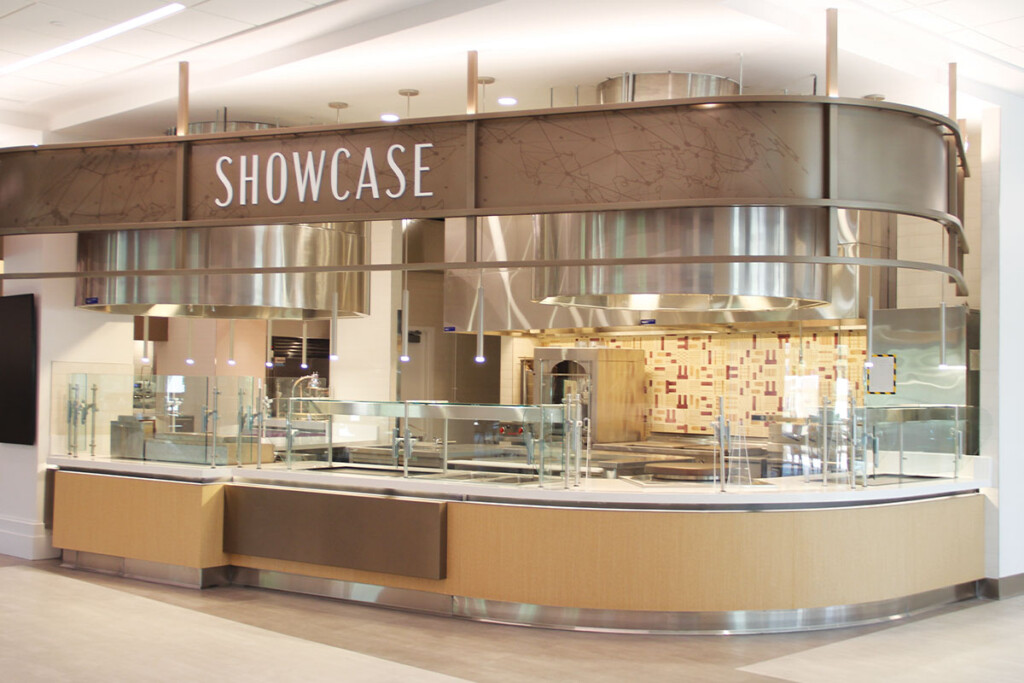
Texas Christian University’s in-house design team had two overarching goals in renovating the nearly 18-year-old Market Square dining facility. First, they sought to create a destination dining spot for TCU students, and, second, to increase meal plan participation to keep pace with the university’s anticipated growth.
The resulting facility wowed everyone. Opened in August 2026, BLUU Dining in the Brown-Lupton University Union—part of a $17 million overhaul for the Union—has welcomed a record number of guests. The reimagined dining hall covers about 13,000 square feet, with an additional 4,500 square feet for the platforms and back-of-house. It’s bright, airy and open, offering seating for 550 inside and 120 on the patio. BLUU Dining features eight food platforms, including a to-go window for students on the move. Its support kitchen earned an all-new equipment refresh.
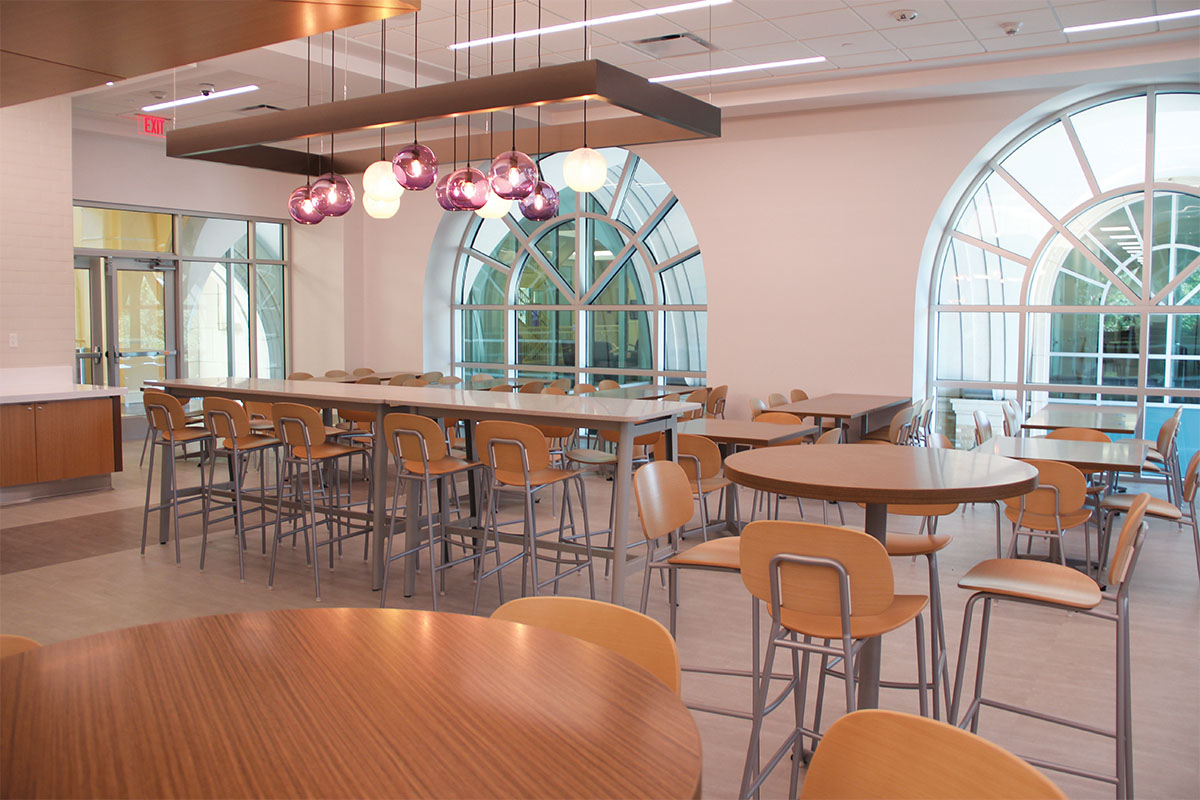
Arched windows bring in light and help draw students to the salad/deli area.
Less than two months after its debut, BLUU Dining meal tallies are averaging 4,000 per day. “That’s double our meal counts at the time we closed for renovation in December 2025,” says Associate Vice Chancellor Student Affairs Business and Operations Jude Kiah. As of press time, its peak day entailed some 5,700 meals. If pushed, “We could probably crank out 8,000 meals per day,” Kiah notes.
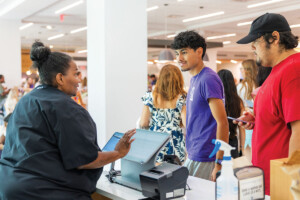
Texas Christian’s BLUU Dining, now a campus-wide destination, features an array of finish-to-order platforms in a bright, spacious setting.
Survey Surprise
Preliminary planning for BLUU Dining began in 2022 with a series of research surveys aimed at gauging student satisfaction with the Union’s Market Square.
“It took quite a bit of data analysis from multiple surveys to figure out that it was the facility—not the food—that students didn’t like,” Kiah recalls. “They perceived the previous dining hall as merely a self-serve cafeteria with premade food.”
Research showed that students valued made-to-order over speed-of-service, and had no issue with waiting for customized meals. “We didn’t believe it at first,” Kiah says. “We must have conducted at least six different surveys, both focus groups and actual surveys, before we finally trusted the results.
“It’s still shocking to me that students will line up 20 deep and not think a thing of it,” Kiah adds. “Our lines do move fast. The other day, I noticed the queue for bowls was 15 deep. When I timed how long it took for the final person to get their food, it was four minutes and 30 seconds.”
Good Growth
Next fall, TCU will add 2,500 beds on campus, Kiah notes.
The dining team opened East End, a dining hall on the opposite side of campus, in January 2025. Over the last two years, staff has revamped menus, with the help of Sodexo’s college dining concept One & All, to encourage dining interest. BLUU Dining aims to further that appeal. Meal plan enrollment currently stands at 6,300, with expectations of surpassing 8,000 in the coming year.
“Opening these two dining facilities has helped it all come together,” Kiah says.
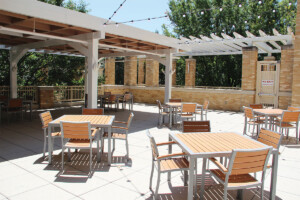
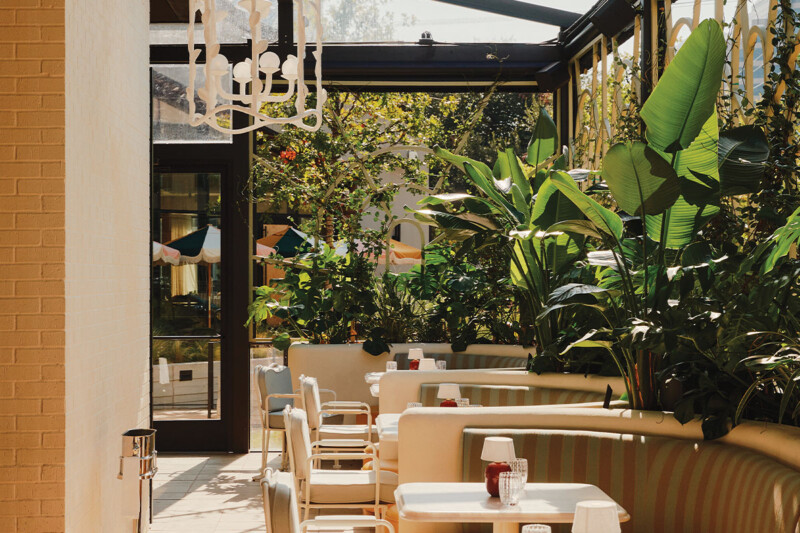
The 120-seat outdoor terrace will be in use nearly year-round.
Designing BLUU
The TCU dining team who oversaw East End’s creation also led BLUU Dining’s renovation. The team includes Kiah, along with Director Facilities and Operations Miles Oller and Sodexo District Manager Scott Majestic.
Thanks to their hands-on experience with East End, “We were pretty assertive about what we wanted for BLUU, and what we didn’t,” Kiah recalls. The team started by addressing pain points in the previous dining hall, then assembled menus (relying on Sodexo’s branded One & All higher education menu program) and drafted equipment ideas. The Webb Foodservice Design team, who also worked on East End, helped confirm and finalize the equipment lists and layouts.
When the trio sat down to make preliminary plans for the new servery, each had a goal in mind. “My first thought was to get rid of walls and make everything brighter and more open,” Kiah says.
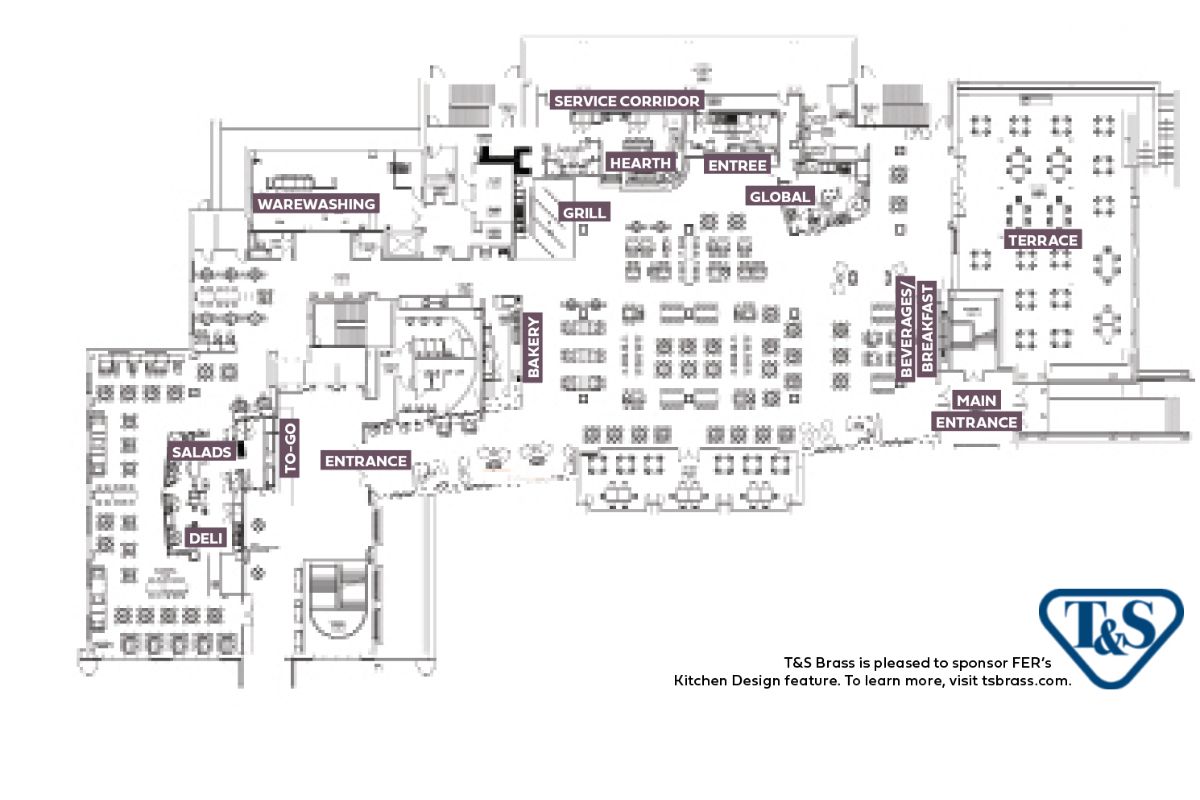
One of the biggest changes involved relocating the salad/deli/to-go platform away from the main area to give the remaining platforms room to breathe, Kiah adds. This move, near a wall of windows overlooking the campus, created a destination dining spot within the servery. “It’s become the most popular space in the facility,” he says. “Students want to sit there because it’s bright and has a view of the stadium.”
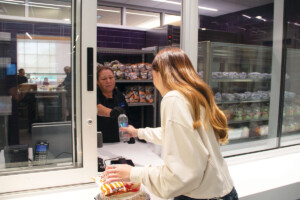
At Dash, students can grab a quick bite without entering the servery.
In an innovative twist, this platform’s to-go window, called Dash, opens into the entrance hallway, allowing time-pressed guests to pick up a premade sandwich or salad without entering the servery. “It’s an opportunity for us to basically steal seats, give students more options and potentially operate late into the evening with very little input from a labor perspective,” Kiah says.
Oller focused on improving back-of-house traffic flow by replacing the previous servery’s too-narrow afterthought of a passageway with a wide corridor. “The new service hall includes individual entrances to every platform, so there is no competition for space,” Oller says. “As amazing as the difference in the front of the house is, the real meat-and-potatoes of this renovation lies behind scenes in the ability to move product from A to B safely and efficiently.”
Oller and Majestic also looked at improving BLUU Dining’s “engine”—its support kitchen and walk-in cooler.
Changes to the support kitchen started with replacing the old, hard-to-clean tile flooring with epoxy flooring. “We had to remove everything to do the floors, and this led us to taking a hard look at the 15-year-old existing equipment,” Oller says. “I knew many of the pieces would not be worth reinstalling once we’d moved them three times, and so we took on the additional project of a one-for-one replacement of nearly everything down there.”
The support kitchen’s new walk-in cooler solved Majestic’s goal of streamlining receiving. “I wanted to be able to distribute incoming product efficiently,” he says, describing the previous convoluted system dictated by space constraints. “With our new 800-square-foot walk-in, we can roll pallets directly into the cooler, unload onto carts, then send product where it needs to go.”
Servery Highlights
Changes large and small add efficiency to the BLUU Dining servery. Planners chose equipment based on capacity, flexibility, maintenance needs and training needs.
The pizza oven serves as a key example. While the interior designers would have liked an eye-catching stone-hearth oven, the team insisted on an industrial-looking rotating pizza oven. “This thing can crank out 116 pizzas an hour and bake casserettes on the lower level,” Oller says. “One worker can be loading from the front and another worker unloading from the side—and no one has to stick their arms into a 550-degree oven.”
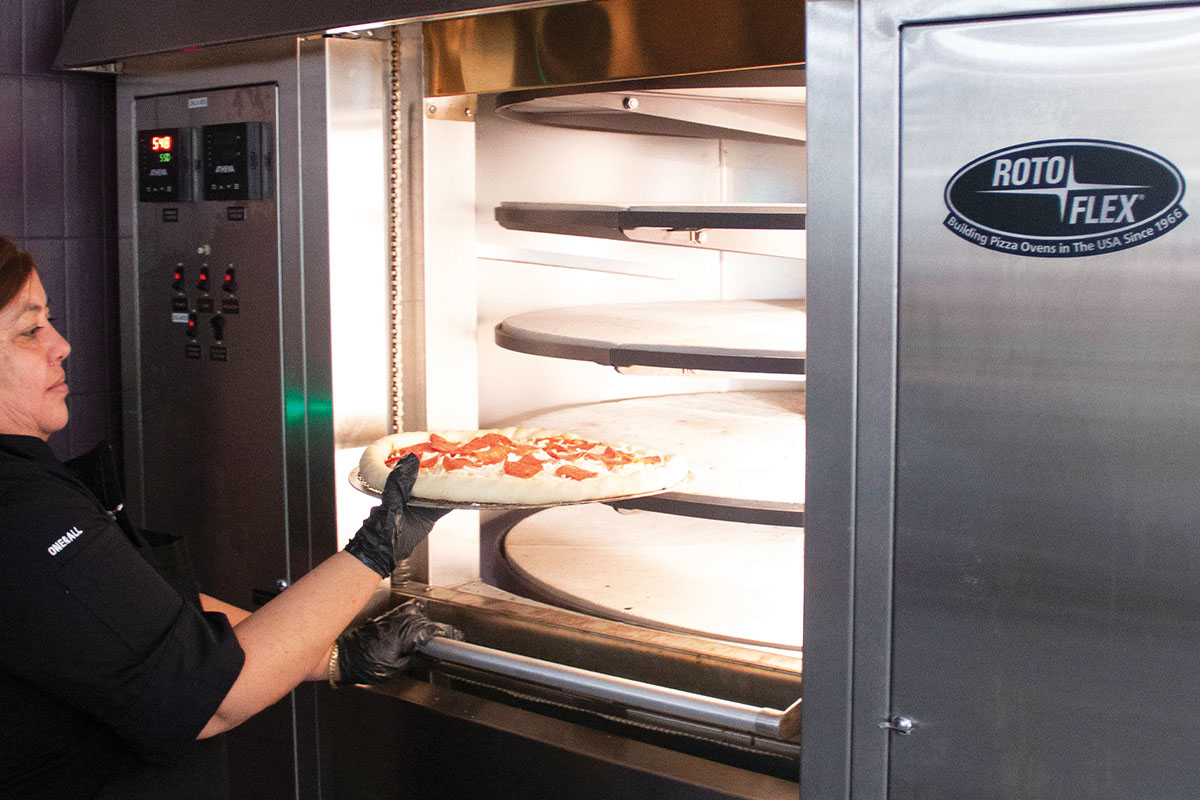
The rotating pizza oven can crank out 116 pizzas an hour.
Other equipment favorites include the customer-facing soft-serve machine (“high-end, low amperage draw, reliable, easy to operate and perfect for this kind of environment,” Oller notes); the round griddle that doubles as a plancha; and a pasta station that can pivot to serving breakfast items as needed.
When it came to choices of high-tech, computer-controlled equipment versus low-tech, the latter generally won. “I’d rather buy ‘tanks’—pieces of equipment that will just keep working, and where you don’t need a master’s degree to figure them out,” Oller says. “The funny thing is, the hardest units for us to replace were some 30-year-old oven ranges still in use from the original makeover. Kenny, one of our maintenance techs, fought me pretty hard because they had never broken down.” The new pieces were by the same supplier. (Kenny was pleased.)
Future maintenance concerns also dictated equipment choices. “We need to avoid one brand of griddle because we’ve had issues getting them repaired around here,” Oller notes. “And we avoid a particular warewasher brand for the same reason.”
TCU’s equipment service company also provided input. “When we picked out a new type of, say, fryer, our service rep researched the prices of its thermostats or other repair parts to give us an idea of future maintenance costs and longevity,” adds Oller.
A Look Ahead
“We needed BLUU Dining to have some gravity (compared to East End), and it is definitely doing that,” Kiah says. “Now we just have to operate it. It’s off to a very good start.”
FACTS
BLUU DINING AT
TEXAS CHRISTIAN UNIVERSITY
FORT WORTH, TEXAS
OPENED: August 2026
CAMPUS POPULATION: 13,500, including about 5,700 living on campus
SIZE: 17,500 square feet across servery, BOH and seating areas
SEATING: 550 seats, plus 120 patio seats
BLUU DINING MEAL PRICES: Breakfast, $12.50; lunch, $14.50; dinner, $16.50
TEXAS CHRISTIAN UNIVERSITY: Jude Kiah, associate vice chancellor student affairs business and operations; Miles Oller, director facilities and operations; Scott Majestic, Sodexo district manager
CONSULTANT: Mike Browne, senior project manager; Daniel Roberts, associate principal; Webb Foodservice Design, Dallas
ARCHITECT: CannonDesign, Houston
DEALER: Baring Industries Foodservice Equipment Co., Fort Lauderdale, Fla. (servery); Mission Restaurant Supply, Fort Worth (support kitchen)
WEBSITE: dining.tcu.edu
KEY EQUIPMENT
Throughout
Streivor hoods
BSI food shields
3M water filtration systems
Advance Tabco hand sinks
Fisher hand sink faucets
Metro roll-in racks
Salads/Deli/To-Go
Vollrath soup well
TurboChef speed oven
Hatco panini grills
RPI deli display case
Panasonic rice cookers
Traulsen two-door roll-in refrigerators
Federal Industries cold display cases
Bizerba slicer
ColdZone remote refrigeration rack
Breakfast
Silver King milk dispenser
Follett ice maker
Hatco heat lamp
Vollrath drop-in hot/cold unit
Taylor soft-serve machine
Bakery
Traulsen two-door roll-in refrigerator
Southbend ventless convection oven
RPI bread display
Hatco conveyor toaster, drop-in hot well, heat lamp, hot/cold shelf
Franke coffee machine
Beverage-Air undercounter refrigerator
Grill
Montague plancha, salamander, cold base, countertop broiler
Pitco fryer
Traulsen reach-in freezer
Vollrath drop-in hot/cold unit
Hatco heat lamp, drop-in heated shelf
Hearth
Traulsen two-door roll-in refrigerator
DoughPro dough press
Roto-Flex pizza oven
Hatco undercounter hot holding cabinet, drop-in heated shelves, heat lamps, decorative lamps
Vollrath soup well
Pitco pasta cooker
Jade undercounter refrigerator, open burners with cold rail
Entree
Traulsen two-door roll-in heated cabinet, reach-in refrigerator, reach-in freezer
Pitco fryer, dump stations
Montague countertop broiler, plancha, cold base
Beverage-Air undercounter refrigerator
Hatco hot/cold shelf, drop-in heated shelf, hot well, heat lamps
Cres Cor carving station
Alto-Shaam holding cabinet
Global
American Range countertop gyro broiler
Wood Stone vertical rotisserie
Montague plancha, cold base
Pitco fryer, dump station with heat lamp, pasta cooker
Traulsen reach-in freezer, sandwich prep table
Hatco heat lamps, drop-in heated shelf
Evo drop-in electric cooktop
Vollrath drop-in hot/cold units
Jade open burners, cold base
Warewashing/Servery Back-of-House
Aerowerks accumulator, hose reel
Salvajor trough collector
ThermalRite walk-in cooler
Cambro Mfg. dry storage shelving
ColdZone remote refrigeration rack
Follett ice maker
Editor’s note: This list only shows new equipment for the servery and not the support kitchen.
T&S Brass is pleased to sponsor FER’s Kitchen Design feature. To learn more, visit tsbrass.com.
ABOUT THE AUTHOR

RELATED CONTENT
- Advertisement -
- Advertisement -
- Advertisement -
TRENDING NOW
- Advertisement -
- Advertisement -
- Advertisement -