
5 Mistakes To Avoid With Dishmachines
Clark Service Group's John Albring points to a few common errors that will take down a dishmachine.
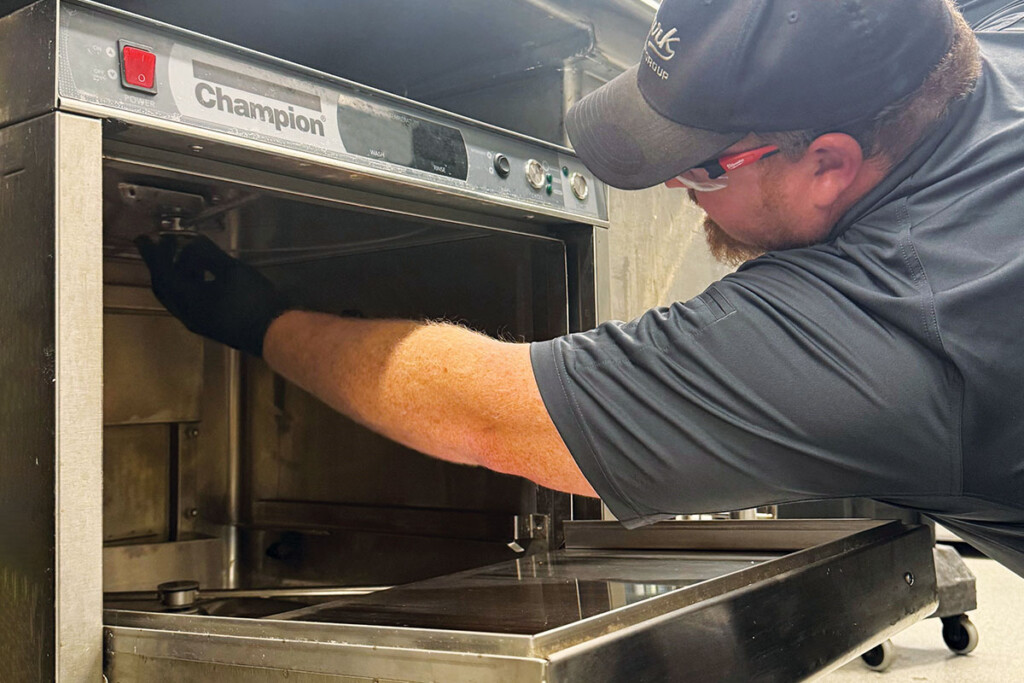
A dishmachine that doesn’t work well sends dirty wares to customers in the front-of-house, and leaves employees with residue on pots and pans in the back-of-house. To keep this key equipment in top shape, and save a service call, John Albring, technical advisor at Clark Service Group, based in Lancaster, Pa., offers the following mistakes to avoid:
Not scrapping wares. Albring, who spent 17 years in the field, has seen numerous calls that stem from condiment packets or similar items getting stuck in impellers. Watch out for poppy seeds, too, which will plug a wash arm in no time. “They circulate and then they get stuck in the wash arms and we have to go out because the dishmachine isn’t cleaning,” Albring says. “Turns out all the wash arms are plugged, so there’s never water actually hitting the dishes.” Make sure employees don’t send extra debris through the machine, and keep the wash arms clean. Many of today’s models come with wash arms that are user-friendly and don’t require any tools to remove, clean and reattach them.
Not cleaning screens. Especially on flight-types, clogged screens could eventually rupture pump seals and suction hoses. “The next thing you know, there’s water all over the floor,” Albring says. “They can’t use the machine and they have a leak.” If a machine is heavily used, cleaning screens should be a daily routine. Employees can remove them, check them and if they’re blocked, use a pre-rinse unit at a nearby sink to blast them out.
Getting the chemicals wrong. Albring has seen machines pull too much detergent, foam up and then the probes don’t read right and they don’t fill properly. He also has seen detergent that is wrong or too concentrated and ends up eating the metal, especially the impellers. “Some models have a bronze impeller and if the right chemicals aren’t used, they can actually eat the impeller,” Albring says. “I just took out a solid bronze impeller two months ago that was almost paper thin and I could bend it with my hands.” In that situation, the cost to the operator was at first a poorly functioning dishmachine, followed by several days of downtime for repairs, which included replacing the impeller and wash pump motor. Use test strips to check the machine is using the right amount of chemicals. And watch the chemical use; if employees are constantly running out of jugs, something’s wrong.
Not regularly deliming. Not performing this task could plug the wash arms and wear out the heating elements. “They’re going to burn out faster if they’re coated in scale,” Albring says. Scale also can coat probes and lead to fill and chemical errors. Next thing, an operator puts in a service call for a technician, who ends up cleaning the probe and recommending a delime cycle run. How often to delime depends on the water quality. If the water is extra hard, it could be as often as once a week.
Improperly loading the unit. “People try to jam large trays or large pots in somewhere where they’re not suppose to fit,” Albring says. “And if they’re surrounded by smaller wares, they might block them from getting washed. Not only that, but they’re going to hit your conveyor drive and your wash arms and they could break something that’s going to end up being expensive.” If the item doesn’t fit in the racks that came with the machine or just looks too big, it probably shouldn’t be in there.
By avoiding these few mistakes, a dishmachine will deliver properly clean wares, keeping the customer experience in check and helping employees prepare quality menu items.
ABOUT THE AUTHOR

RELATED CONTENT
- Advertisement -
- Advertisement -
- Advertisement -
TRENDING NOW
- Advertisement -
- Advertisement -
- Advertisement -