
What To Look For in a Pizza Prep Table
As makers roll out more choices, you’ll want to study the field before hitting a stride with pizza prep tables.
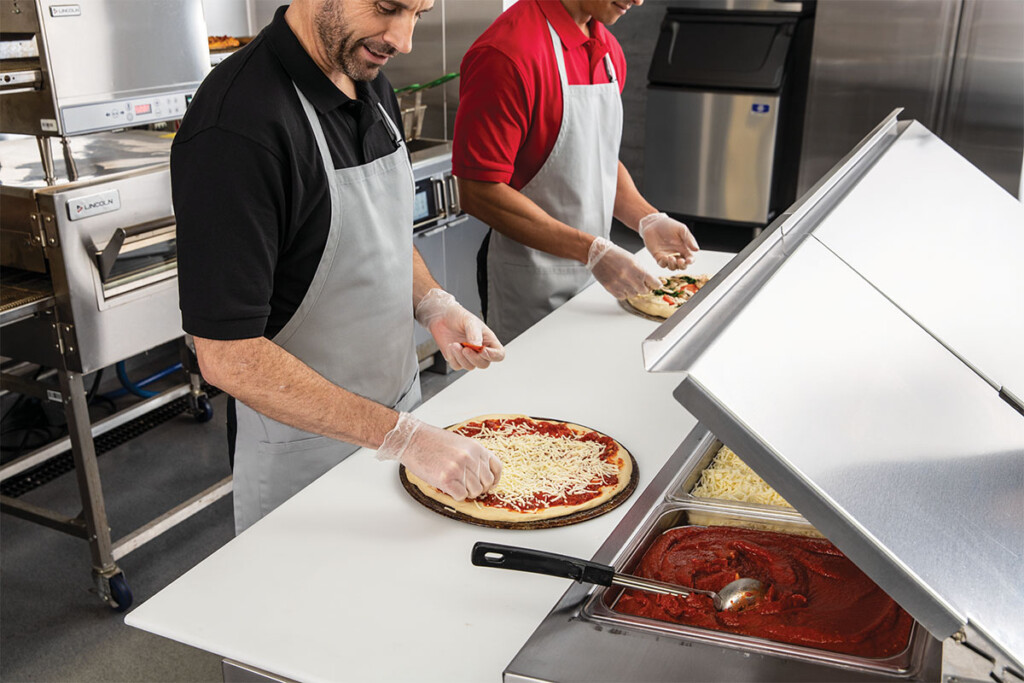
While van Gogh very well may have been an adept finger painter, the world at large benefited from him having more advanced, though simple, tools at his fingertips. So, too, should an efficiency-minded pizza establishment.
After all, from Chicago to New York, pizza-making is a highly personalized art.
A pizza prep table—which stows cheese, sauce, toppings and, sometimes, dough, for quick assembly—marks a core piece of the lineup for many.
Coming Soon
Look for at least two product releases at the National Restaurant Association Show this May. For one maker, the new offering’s biggest selling point will be how it catches spilled ingredients, keeping them at food-safe temperatures to enable potential food-cost savings.
Pan cooling formats vary, with some newer units looking to improve consistent top-to-bottom chilling. Courtesy of West Star powered by Kwick Cool.
The other unit, with a granite top, has three sections—one for dough, one for bulk storage and a chilled pan rail. Conscious refrigeration formats help each chamber do its job. In the dough chamber, the air comes down on the side like an air curtain. “It comes out slow, so it’s not hitting any of the product, and it refrigerates it, so the dough stays good without crusting,” they say. In the pan shoulder, sensing probes mimic food temperature rather than air temperature for added efficiency and temperature accuracy, they say. Both this unit and a prior model from the maker earned Kitchen Innovations Awards.
Prep Work
In today’s competitive pricing environment, pizza margins are tighter than they once were, points out one maker. So, finding the right pizza prep table—one which not only helps your pizzas get out quickly and easily, but also one that’s reliable for years to come—can be quite impactful.
Here’s what makers suggest:
Start big picture, sizing up dimensional and locational limitations. Generally, pizza prep tables range from 43 inches wide with one section, to more than double that with three sections. Note that the unit with the largest frame doesn’t necessarily have the most usable space; pay close attention to components’ placements and how they impact the prep table’s layout. If a unit is going in the front-of-house, consider airflow and temperature fluctuations (for example, from an exterior restaurant door opening). Food shields also are a likely addition in a customer-facing use. In the back-of-house, environmental fluctuations also should be considered, chiefly from ovens, which add heat, and vents, which can impact airflow. If having an oven near the prep table makes for the best operation flow, look for heat deflection options and recommendations to ensure you’re not taking in hot air to the unit’s detriment. Similarly, condensing unit locations can be flipped with select makers. This swap, one such maker says, could add years to the equipment’s life for an operator with a neighboring heat source or a lot of flour in the area. “A lot of equipment today is ‘you-get-what-you-get,’” they say. “Adding the in-the-field modification options are huge and could save an operator some serious money in the long run, since the equipment can adapt to their needs instead of the other way around.”
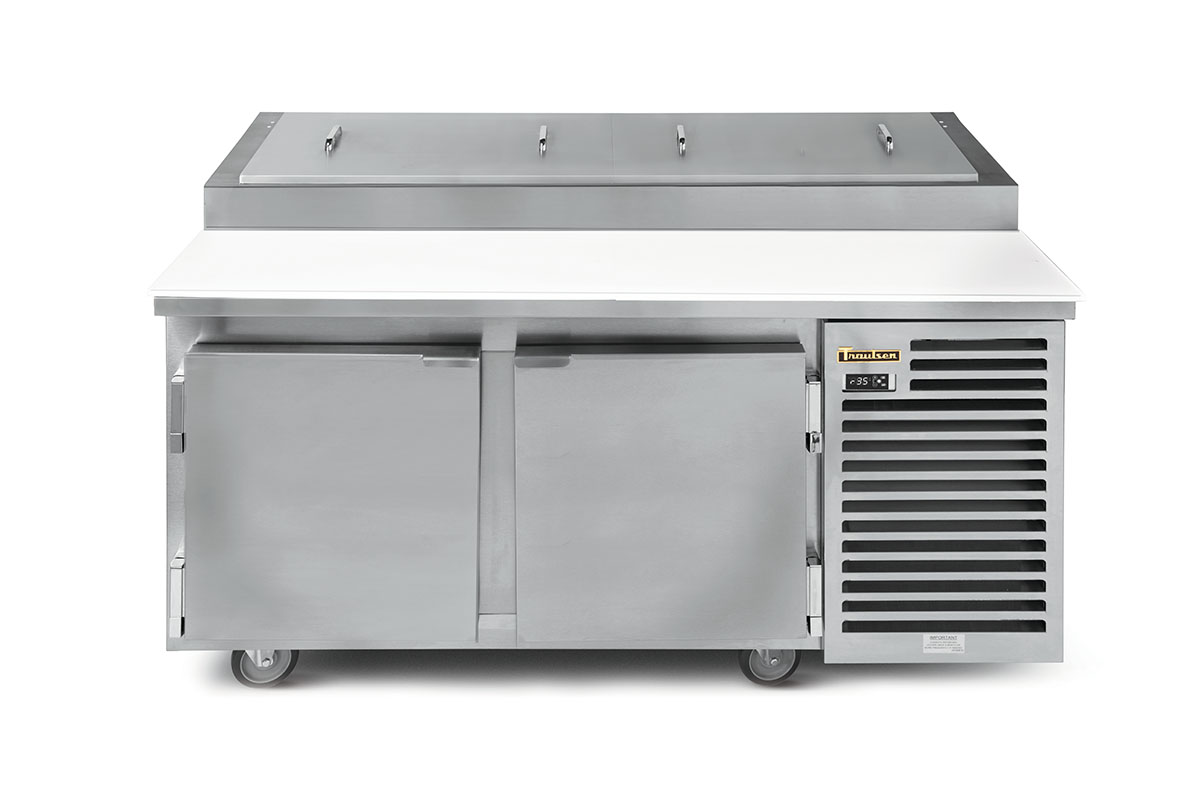
Think through kitchen flow and how it may be impacted by a pizza prep table’s doors opening, among other details. Courtesy of Traulsen.
Take stock of details and options. Within any given footprint, an operation’s flow will vary, both functionally and environmentally. Drawers and doors are worth a second thought. “Sometimes people want doors because they’re holding dough on sheet pans, but drawers are nice because you can open them (partially),” says one maker. Drawers also may be preferable for storing balls of dough. The cutting board also should be considered. If you plan to cut an 18-inch pizza, for example, an 8-inch depth won’t cut it, so to speak. Cutting board material options also vary, with options like plastic, granite and composite. Also think through what lid style best serves you; options include removable tops that can hang by a hook during peak hours, as well as transparent or metal lids that slide up or back. With some units, ambient conditions also become important when thinking of lidless operation. Overall, “people don’t pay attention (to details) until it becomes a cumbersome issue and it costs some labor efficiency,” says one maker.
Quantify your ingredients. In many ways, footprint-and-ingredient considerations are closely linked. For a creative solution for space-strapped operators, one brand offers a second refrigerated rail on select 48-inch or 72-inch prep tables, allowing operators to gain storage space vertically, rather than looking to a unit with a larger width or depth. In addition to coils, each of the unit’s pans, on the upper and lower rail alike, are surrounded by liquid cooling technology for wrap-around refrigeration contact to drive consistent temperatures, whereas a pan with less-direct contact might have frozen ingredients on the bottom and warm ingredients up top. This particular unit’s rail and base also have separate refrigeration system shutoffs. “All they have to do is take that product from the top rail, put it in the base and shut off the rail for the night,” the maker explains. “They don’t have to take it to the walk-in, and they don’t have to get a reach-in next to it. We’re really trying to mitigate them having more expense, whether in waste or the investment in other products to complement what they could get in (one product).” Some models also allow overnight storage in the pan rail. “Some of the most advanced systems even eliminate the need for defrost, reducing potential downtime,” one manufacturer says. This year, another brand debuted a dry storage ingredient rail option, available across its portfolio of pizza prep tables. On the refrigerated ingredient side, this same maker stows a refrigerated compartment above the compressor—standard as a door but field installable as a drawer—to help maximize storage space.
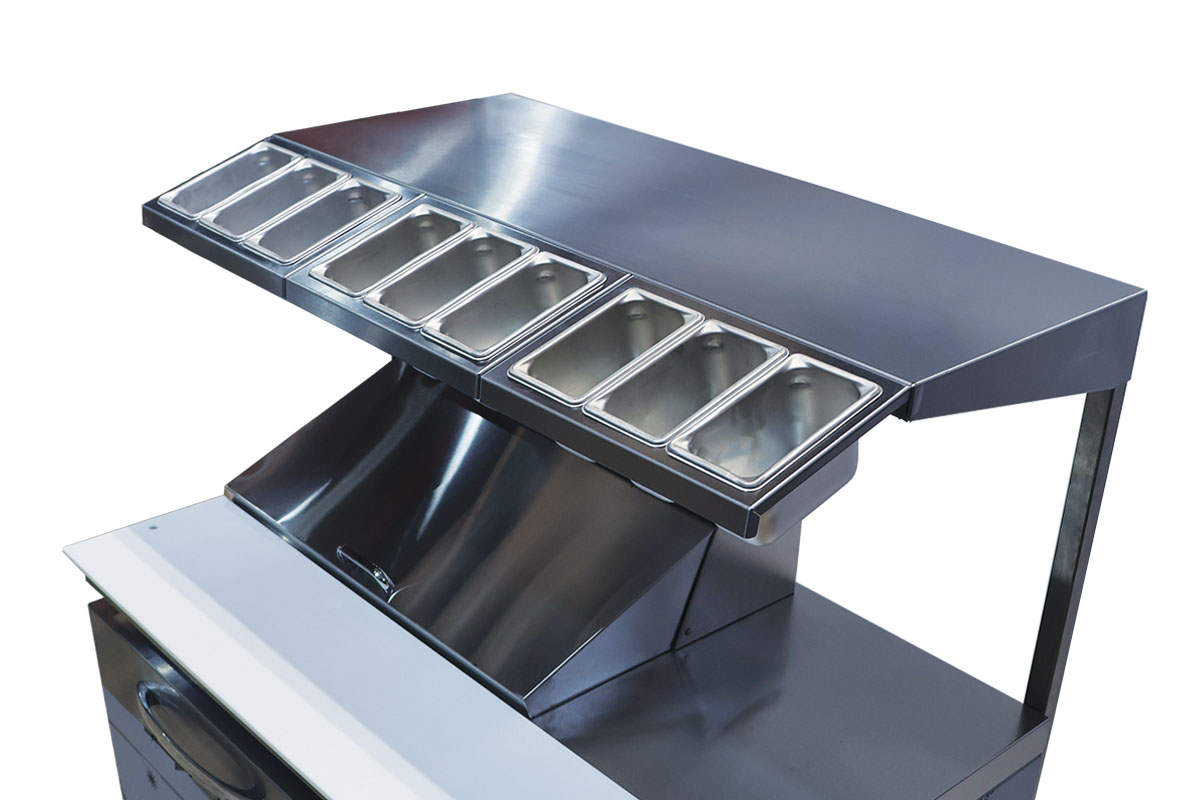
Customizable add-ons like storage rails can go a long way in terms of capacity and operational flow. Courtesy of Continental Refrigerator.
Consider your menu mix. Are you offering gourmet pizzas garnished with microgreens and truffles, plus multiple sauces, or do you simply need space for a handful of basic toppings? “If you’re only doing five different pizzas, you could get away with a sandwich prep table,” suggests one maker. Or, if you’re somewhere in the middle, with a potential pizza menu expansion on the horizon, consider how or if your prep table may need to change down the line.
Study built-in product support. Prepurchase, at least one maker offers a 90-day equipment trial period, plus test kitchen access. Post-purchase, warranties and service relationships vary. Parts and labor coverage generally spans one to seven years, and compressor coverage goes up to seven years with the brands we spoke to. At least one maker offers lifetime coverage on its drawer tracks, which tend to see wear and tear with frequent opening and closing, and even occasional use as a staff stepladder. Another maker touts the longevity of their heavy-duty stainless hinges and drawer guides, and says to watch out for other units with plastic wheels or aluminum components. Generally, makers suggest thinking through OEM parts availability to potentially save money in the long run. “We are a premium product at a premium price for a reason,” says one manufacturer. “Now, can you find something that’s half the price and can ship in 24 hours? You sure can, but in a year-and-a-half when it fails and you can’t find factory OEM parts to replace it, and now you’ve got a dead unit, you’ve got to go out and buy another one.” Other makers echo this sentiment, urging operators to consider the long-term savings that might come with more energy-efficient, feature-rich models.
Post Prep
Once your unit is in place, keep up with advised maintenance, per your maker’s guidelines. While many do remember to wash debris from gaskets, also be sure to check gaskets for tears to ensure proper sealing and temperature retention. “That’s really the beginning of the end, because now you’ve got air intake, now you’re going to freeze up a coil,” one maker says. “It’s like a domino effect.” To combat potential tears, one maker added a metal guard covering the gasket; with this addition, food cannot fall between the cracks, they say.
Some makers also tout easy-access condenser coils for simpler cleaning. Cleaning the inside of the drain pan, cleaning the condenser and wiping out the interior, particularly if dough is stored down below, mark a few other suggested points of upkeep.
Table Stakes
Weigh some of the newest options and features on pizza prep tables before going all in on a model.
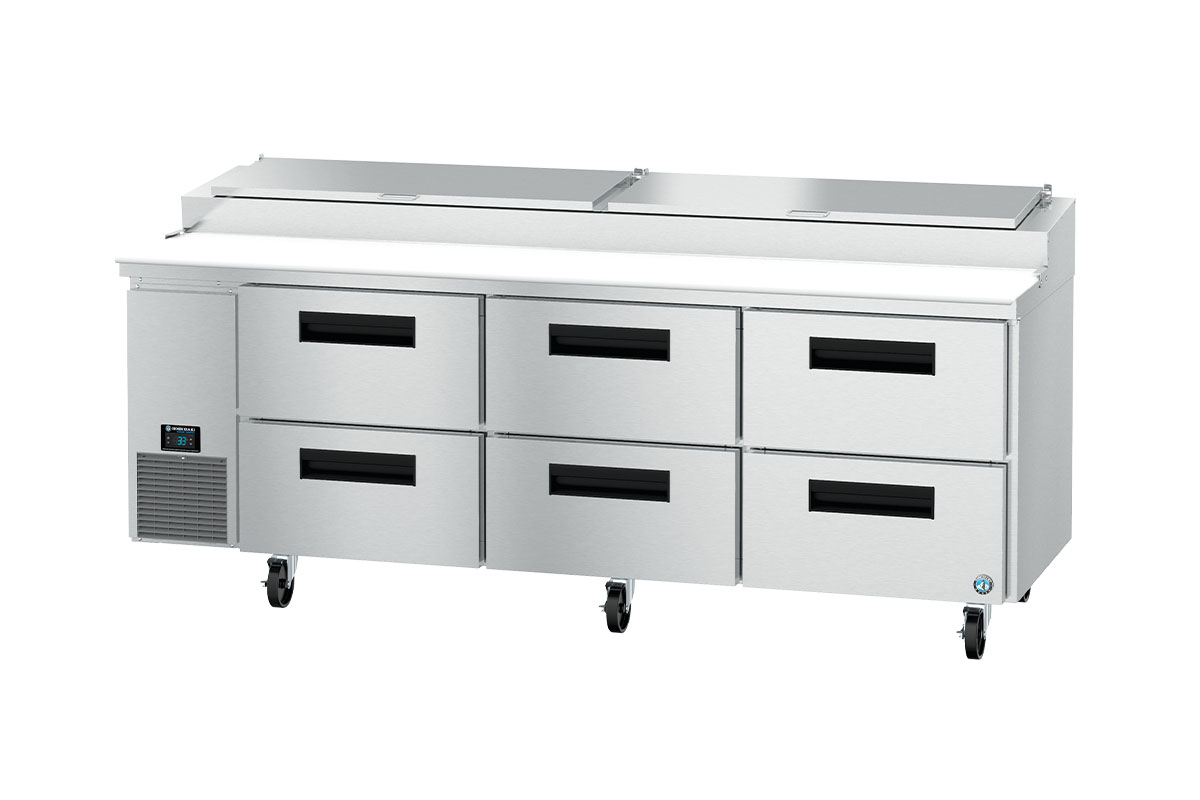
Hoshizaki
Model: PR93B-D6
Details: Back-to-front airflow and a ducted distribution system drive more even cooling across 12 pans on the rail. Automatic temperature adjustments, driven by lid position, let food be left overnight, with the lid closed, without freezing. Set separate temperatures for the rail and cabinet.
Warranty: Seven years on labor, parts and compressor
Website: hoshizakiamerica.com
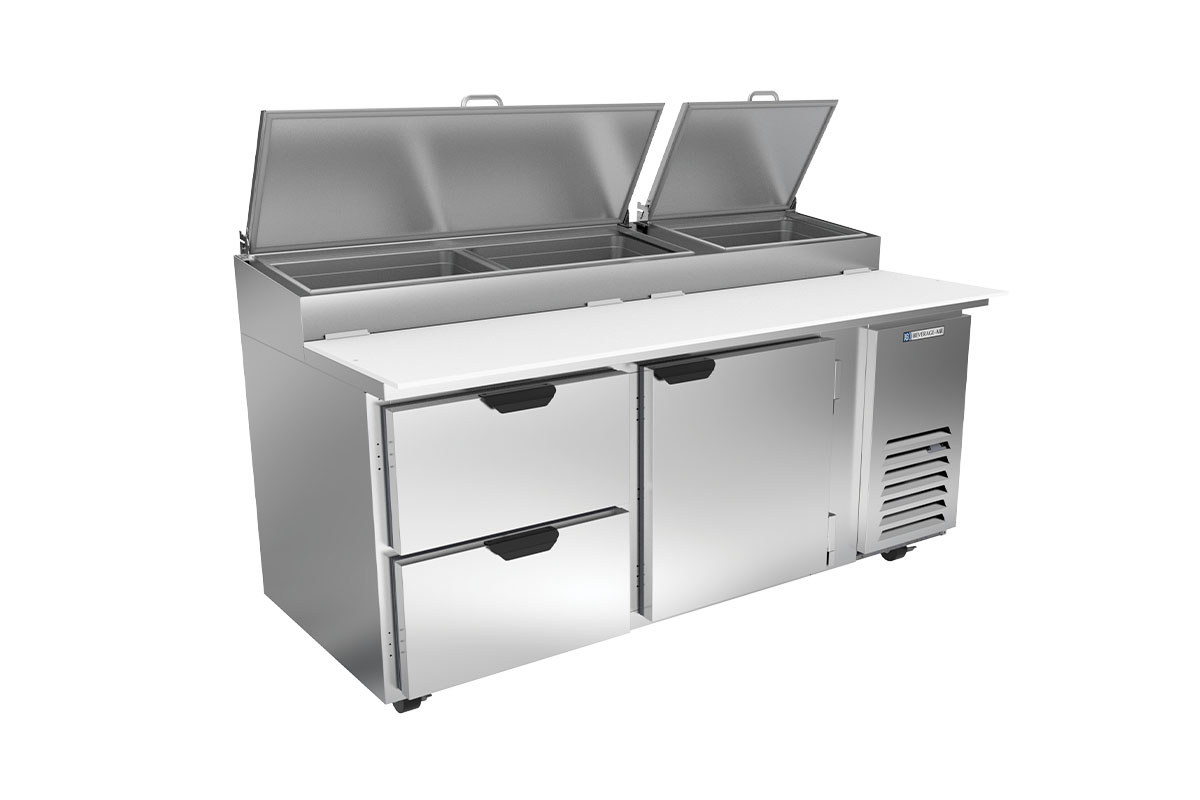
Beverage-Air
Model: DPD72HC
Details: Store ingredients in 6-in.D pans (not included), and spec the condenser on the left or right. Look to the lids for newer updates, including dual open positions (70° for daily use and 90° for access during cleaning and maintenance) and spray-foam insulated, gasketed lids for improved insulation, compared to traditional sheet-metal designs. Further, prep surface depth was increased to support large pizzas.
Warranty: Seven years on labor, parts and compressor
Website: beverage-air.com
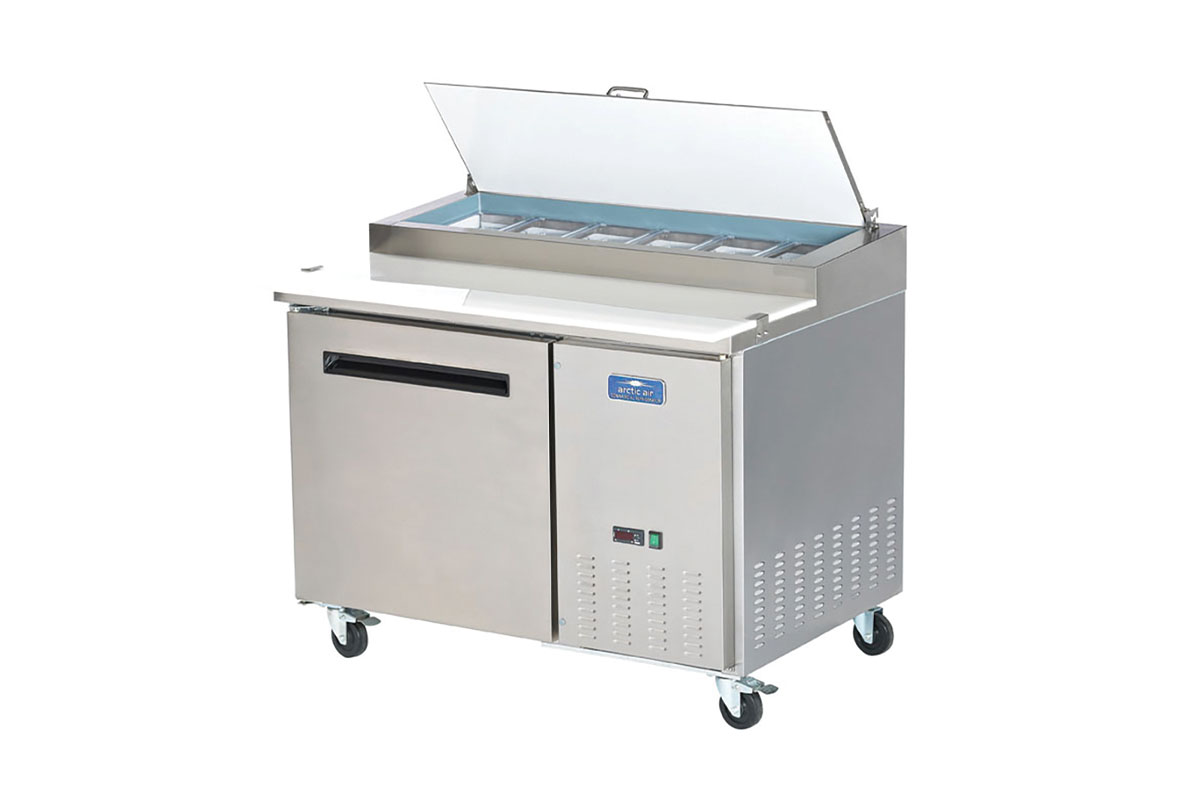
Arctic Air
Model: APP48R
Details: A 28-in.D self-closing door remains open at 90°, and the rail holds six clear pans, which come included. The cutting board spans 47½-in.W x 17¾-in.D, and, below the board, an electronic thermostat with digital display shows the current temperature within. Adding user-friendliness, the magnetic door gaskets can be removed and replaced without tools.
Warranty: Two years on parts and labor, and five years on the compressor
Website: arcticairco.com

Turbo Air
Model: TPR-67SD-D2-N
Details: A self-cleaning condenser, consisting of a fine mesh filter and rotating brush, works to block and remove dust daily. A forced air system drives cooling and maintains temperatures below 41°F, even when lids are open, says the maker. Pans are separate from compartments below to prevent spills into the cabinet. Stainless shelves and a stainless interior simplify cleanliness.
Warranty: Five years on parts and labor, and seven years on the compressor
Website: turboairinc.com
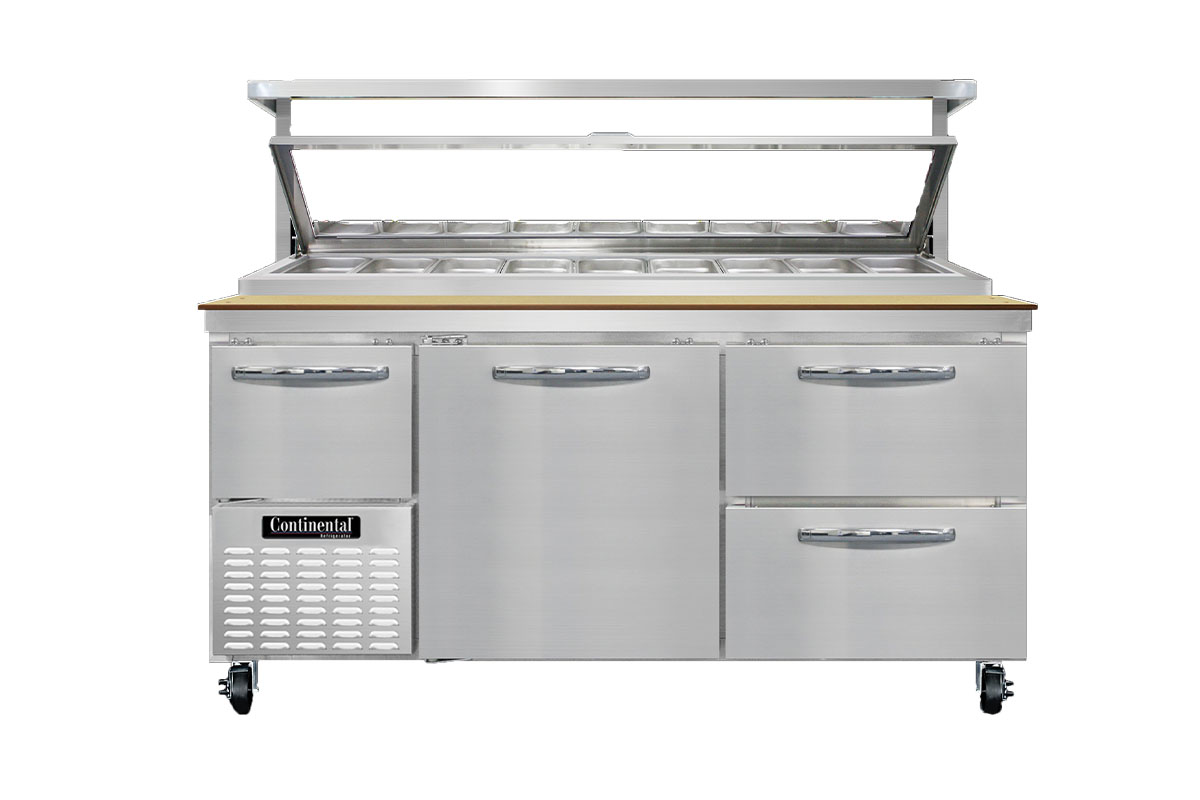
Continental Refrigerator
Model: PA68N
Details: Field reversible doors, and condensing unit location options add flexibility to this nine-pan model. To add storage capacity to this or any other Continental pizza prep table, the maker recently debuted storage rails (pictured in article above) for dry ingredients, utensils and more. The rails can span the entire width of a unit, or be modified to fit a certain section.
Warranty: Seven years on labor, parts and compressor
Website: continentalrefrigerator.com
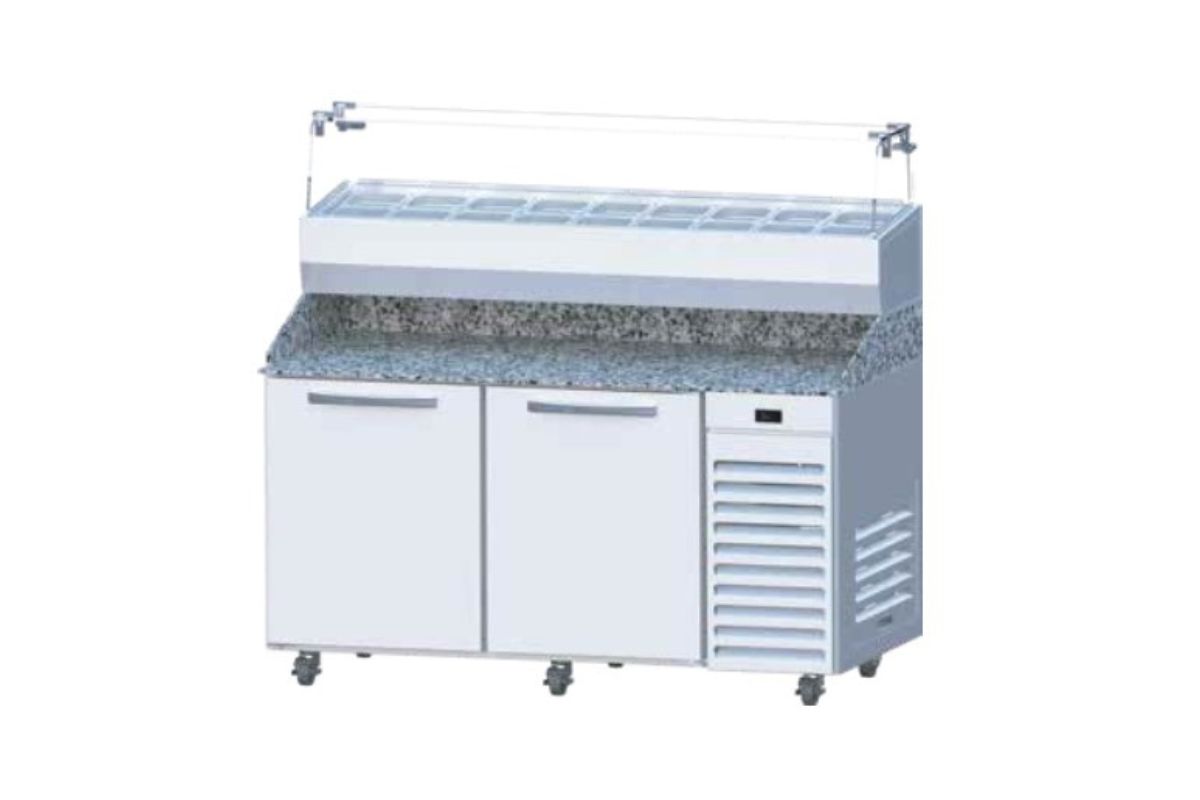
West Star powered by Kwick Cool
Model: WSPP-66TZ
Details: Make use of three dedicated zones: a chilled, full-length pan rail, a retarder/refrigeration section with a pan rack and adjustable controls, and a separate refrigeration section. The unit has a stainless exterior and interior, plus stainless gasket guards and a granite top.
Warranty: Five years on the compressor (minus labor), and two years on parts and labor
Website: weststarindustries.com
Editor’s note: Featured models have been introduced or updated since May 2022.
ABOUT THE AUTHOR

RELATED CONTENT
- Advertisement -
- Advertisement -
- Advertisement -
TRENDING NOW
- Advertisement -
- Advertisement -
- Advertisement -