Convection Ovens Step Up Abilities
Convection ovens’ added features improve precision and bring efficiency on the cookline.
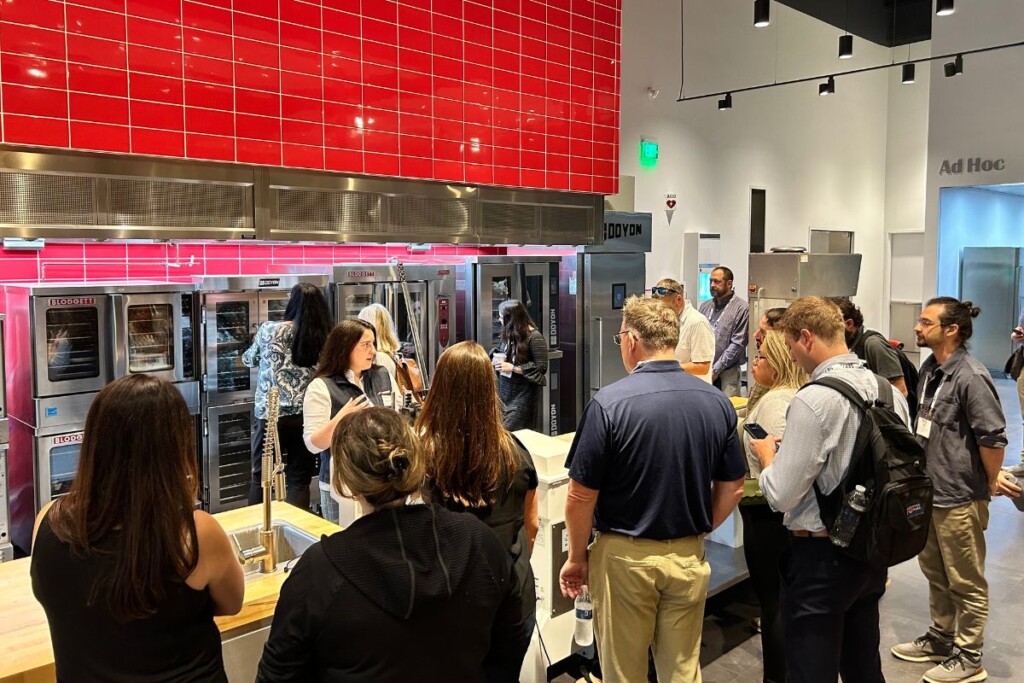
Convection ovens are enjoying the spotlight, thanks to innovative new features and technologies. Long known for being relatively easy to use, dependable and affordable, now there are even more ways a convection oven can benefit operations.
The new features help make convection ovens an affordable option for operators looking for flexibility in cooking and equipment that’s intuitive for anyone in the kitchen to use. Integrating the same type of programmable menus and touch screens as combi ovens helps make this equipment work precisely, taking away the need for an employee to watch over the cooking process. And installation is less of a hassle. There’s no need to bring in a water line, and ventless options eliminate the need for a hood.

High-volume operations will want to take note of interiors, as some offer capacity perks. Courtesy of Garland.
Adding Programmability, Improved Control
Foodservice equipment is getting smarter, and convection ovens are no exception. “Recently, we’ve seen some evolution in the area of touch screen controls,” says one manufacturer. “We’ve taken the technology present in combi ovens and refocused our efforts into convection, showing they can be just as programmable with a little innovation.”
At least three manufacturers have launched lines or reboots of convection ovens in the past year that now include programmable touch screen control panels. The ability to load hundreds of recipes helps make using the oven easier for employees while at the same time improving consistency in cooking. “You don’t have recipe errors like you sometimes would relying on a timer and a knob controller,” one manufacturer says.

Temperature probes come standard on some models. Courtesy of Southbend.
In addition to the programmable controls, some new convection ovens also have a temperature probe, including a wireless probe offered by at least one manufacturer. This improves cooking as well, allowing for precise temperatures and doneness. It’s helped improve the versatility of convection ovens, making them even more adept at roasting and even cook-and-hold techniques.
Going with the (Air)Flow
It’s pretty simple to describe how convection cooking works, as it’s basically hot air moving around in a box. But what gets more complicated is how the air is moved and the power behind it. Recently released lines of convection ovens have been engineered to cook more evenly and efficiently through a number of different techniques.
One manufacturer uses burners that fire horizontally, allowing for a shorter burner box and a more effective way of producing heat, as compared to tube-style burners that fire vertically, they say. Because of the effective heat source, it’s able to increase the Btu, which in turn leads to quicker recovery temperature in the oven when frozen products are put in during a cooking cycle.

Select models cook with impingement. Courtesy of Blodgett.
Two new offerings combine forced air with an additional element for improved cooking. One line launched in 2025 added impingement heat to the convection cooking. Based on the temperature parameters set by the operator, the oven can adjust the air delivery technology, allowing for either gentle air or more intense heat. This allows operators to get high-quality, evenly browned baked goods like croissants and muffins, while also being able to produce pizzas and wings in a matter of minutes.
The other addition to the forced air of convection cooking is the integration of a jet plate design. This allows energy to be transferred from the center to every edge of the cooking surface. The air comes out from both the top and bottom, with the plate helping drive energy from the center out to every edge of the cooking surface. This allows air to flow under the pan in a full uniform pattern for more efficient cooking and more even browning. As an added benefit, it eliminates the need for rotating pans, so the employee can work on other things rather than having to sit and watch products in the convection oven.
Controlling airflow is just as important as how the air is pushed out. “As we look to improve on convection ovens, one priority for manufacturers is finding ways to bring in new technology to improve energy use. Better control of air pulsing is one way to achieve that,” says one manufacturer. Convection ovens that feature programmable controls and probes can provide greater control over air delivery by sensing what is being cooked and using air pulsing mechanisms to adjust as needed.
Improved humidity control is another feature found in one manufacturer’s latest ovens. Even though convection cooks with a dry heat, some types of food add moisture as they cook. By using an exhaust fan and an internal door that cycles on to open and close, this manufacturer found a way to draw humidity out of the oven.
Updating The Structure
The upgrades to convection ovens go beyond electrical and mechanical features to actual structural changes that benefit operators. One new line of ovens is made with a marine-grade stainless welded compartment. Unlike the liners found in many convection ovens, this compartment has no cracks or seams. Therefore, it eliminates the possibility of oil-laden vapors seeping in and building up on the electronics and insulation of the interior, which could eventually lead to problems and potential downtime.
Another manufacturer found a different way to reduce the grease problem. Convection ovens are made with a glass window for visibility, and those are dual-paned for added insulation. But as soon as the blowers start doing their job, air moves around and grease can seep in. Before long, it’s hard to see in the oven. Thanks to a different manufacturing process, one redesigned convection oven line includes a completely sealed dual-pane glass window with no way for grease to get in. This allows employees to see through the window to check on items in the oven, without having to open the door and start the recovery process.
Getting the Right Oven
Convection ovens’ dry-heat cooking makes them a good fit for almost every type of operation, from bakeries and independent restaurants to K-12 schools and large chains.
The most important thing is to know your own specifications before making a purchase. You don’t want to get a convection oven that’s too small to handle your load, or one with a lot of bells and whistles that you’ll never use.
As with any equipment purchase, it’s important to know the volume of your operation. Convection ovens come in full and half-sizes, as well as countertop options. One manufacturer has designed the interior to be slightly bigger than standard convection ovens, at 24 inches rather than 20 inches; this offers enough room to hold six pans rather than the standard five, ideal for high-volume operations.
You’ll want to consider kitchen space as well. Convection ovens can be stacked to allow twice the amount of cooking in the same amount of floor space. No room under the hood? Look into the ventless options now available.
The next thing to consider is menu. Some new convection ovens have separate cooking compartments, each with independent controls, which can be a plus for operations with a variety of foods that take different times to cook. Operations that have a lot of proteins on the menu might opt for convection ovens with a probe for more precise cooking.
Volume and menu both play into the consideration of recovery times. Think about how often you’ll be opening the door, and whether you’re cooking a lot of frozen items. One manufacturer offers ovens with 50,000, 70,000 or 90,000 Btu. The lower option meets Energy Star standards, which could be important especially in states that offer rebates (visit energystar.gov/rebate-finder). But the higher Btu results in quicker temperature recovery after the door is opened, which also is a consideration in energy use.
Whatever option you choose, today’s convection ovens only improve on this equipment’s reputation of being able to produce consistent, high-quality products at a relatively affordable cost, making them a cost-effective way to bring added efficiencies to the kitchen.
Batch of Options
Peruse 10 convection ovens’ controls, cooking capabilities and more features.
American Range
Model: Majestic Bakery Depth
Features: Take advantage of a half-hp. fan for baking and roasting, plus side-to-side sheet pan compatibility. Units come standard with glass doors, or specify optional solid doors.
Website: americanrange.com
Moffatt
Model: Turbofan E35D6-26 (on the SK35 stand)
Features: This model offers capacity for up to six full-size sheet pans. Cook manually or by program, plus take advantage of five steam injection levels.
Website: moffatusa.com
Southbend
Model: Platinum Pro Series
Features: Horizontally firing in-shot burners add efficiency. Choose from standard or touch screen controls, plus an option for two wireless probes on touch screen models (with two wired probes on standard models).
Website: southbendnc.com
Wolf
Model: WC4ED
Features: A two-speed fan adds versatility to this electric, Energy Star certified unit. Adjust racks as needed across 11 positions, and flip a switch for rapid cooldown.
Website: wolfequipment.com
Vollrath
Model: CO4-208240FS
Features: Steam control enables browning and crisping. This zero-clearance line is suited for smaller restaurants and coffee shop operators looking to bake, defrost, warm and reheat fresh or frozen products.
Website: vollrathfoodservice.com
Vulcan
Model: VC5ED
Features: Set oven temperature up to 500°F using solid-state controls, and timers up to five hours. Use gentle bake mode for select products. Ease maintenance with built-in diagnostics.
Website: vulcanequipment.com
Garland
Model: Master Series
Features: Digital controls, offered on select units in the series, offer quick access to recipes, cook-and-hold programming and timers. Across the line, choose from gas or electric, single or double-deck, standard or deep-depth models.
Website: garland-group.com
Alto-Shaam
Model: Origin*
Features: Vertical airflow and four shelf-specific digital timers enable product consistency for more hands-off operation. Removable jet plates are machine-washable. Further, a digital temperature display, heat-on indicator light and sound alerts add operational visibility. Choose from electric or gas models.
Website: alto-shaam.com
*This model is expected to launch in Q2 of 2026.
Blodgett
Model: DFG-100-ES
Features: A newer programmable touch screen control enables recipe programming, HAACP storage capabilities and more. A probe adds cook-and-hold capabilities. Choose from glass windows or solid stainless doors.
Website: blodgett.com
Unox
Model: Cheftop Mind.Maps Convex
Features: Manage up to 10 cooking processes at the same time on this electric model. Use cooking features to bake, roast or brown products quickly and evenly. Integrated Wi-Fi enables management of HACCP data and more.
Website: unox.com
Editor’s note: Models have been released or updated since 2023.
RELATED CONTENT
- Advertisement -
- Advertisement -
- Advertisement -
TRENDING NOW
- Advertisement -
- Advertisement -
- Advertisement -